If you ride an electric scooter regularly, your battery is the single most valuable and most fragile component you own. It determines how far you go, how fast you get there, and how much you will eventually spend on a replacement. A high-quality electric scooter battery can cost anywhere from $200 to $600 or more to replace. The good news is that with the right smart charging habits and a little daily awareness, you can dramatically extend your battery’s life, sometimes doubling it compared to riders who charge without thinking.
Understanding Your Electric Scooter Battery First:
Before we talk about what to do and what not to do, let us make sure you actually understand what you are working with. Most modern electric scooters use lithium-ion batteries, and this specific chemistry is what everything else in this guide is built around. Lithium-ion batteries are lightweight, energy-dense, and capable of hundreds of charge cycles, but they are also sensitive to voltage extremes, temperature abuse, and improper charging in ways that lead to permanent, irreversible damage.
A battery cycle is one complete discharge from full to empty and back to full. According to Battery University, lithium-ion batteries can last between 300 and 500 full charge cycles before noticeable degradation begins. However, the way you charge dramatically affects this number. Shallow partial cycles, meaning you only discharge 20 to 30 percent before recharging, are much gentler on the cells than deep full cycles. Riders who follow proper charging protocols frequently push their batteries well beyond 500 cycles with minimal degradation, effectively doubling the rated lifespan.
The other component you should know about is the Battery Management System (BMS). Every quality electric scooter has one built in. The BMS is the electronic brain that monitors battery voltage, current, and temperature, and protects the cells from dangerous conditions. It prevents overcharging, manages discharge rates, balances individual cell voltages, and in premium models, includes temperature sensors that prevent charging when conditions are unsafe. Understanding that the BMS is your battery’s guardian helps you understand why certain habits that seem harmless can actually undermine what the BMS is trying to protect against.
The 20 to 80 Percent Charging Sweet Spot:
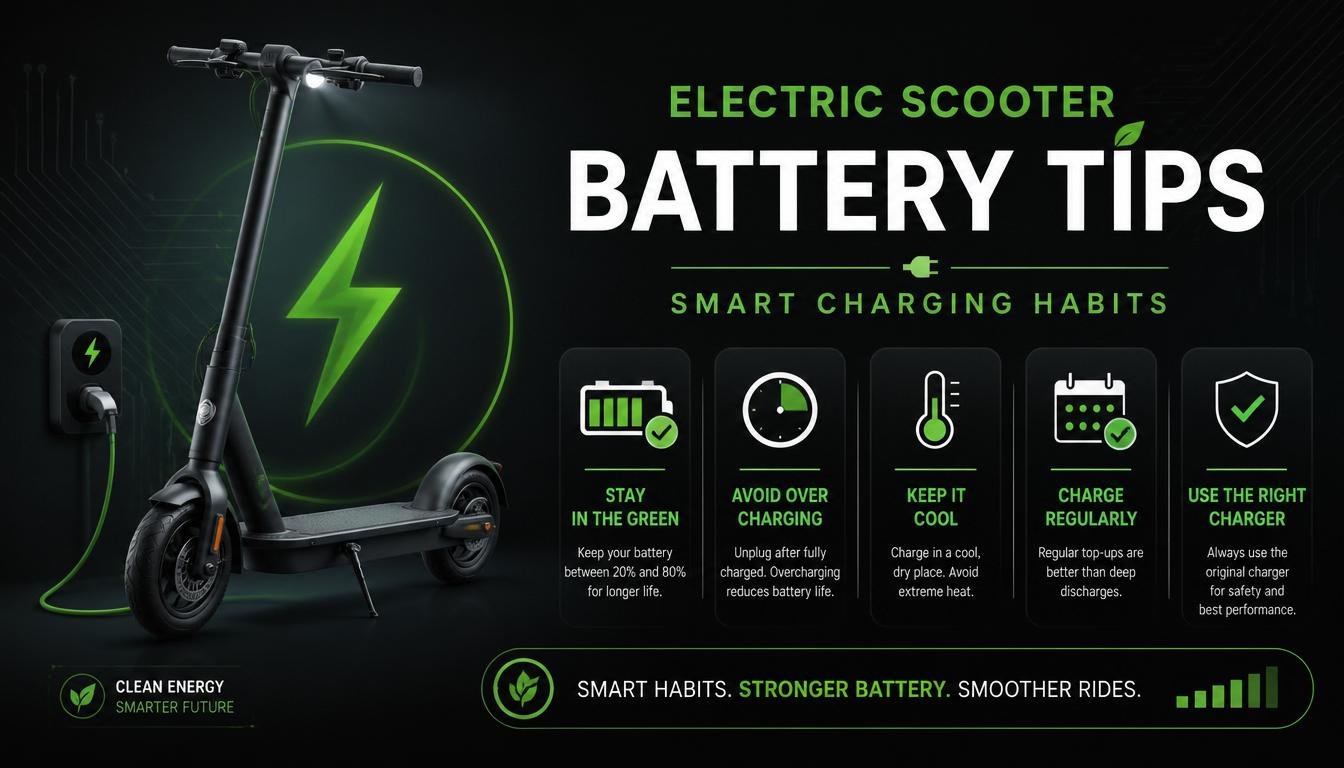
If there is one habit that will make the single biggest difference to your electric scooter battery life, this is it. Charge your battery to no more than 80 percent for daily use, and never let it drop below 20 percent before recharging.
This is called the partial charge rule, and the science behind it is conclusive. At full charge, meaning 100 percent, the battery is in a high-voltage, high-stress state known as lithium plating, which reduces the total number of usable cycles over time. At the other extreme, deep discharging below 20 percent damages the cell’s internal structure. Repeatedly hitting both of these extremes is the fastest way to permanently reduce your battery’s capacity.
Keeping your daily charge level between 20 and 80 percent minimizes stress on the electrodes and significantly extends the total cycle life of the battery. For most commuters and daily riders, this range covers more than enough range for a typical day’s riding. If you are planning a long trip and genuinely need maximum range, charging to 100 percent for that specific ride is perfectly fine. The damage comes from charging to 100 percent every single day as a habit, not from doing it occasionally when you actually need it.
Think of your battery the way you think about your own energy. You would not run yourself to complete exhaustion every day and then force yourself to stay maximally alert around the clock. Some days you need the full capacity. Most days, a comfortable middle range is exactly where both you and your battery perform best.
Smart Charging Habits That Protect Your Battery Every Day:
Beyond the 20 to 80 percent rule, there is a set of daily charging habits that protect your battery in ways that compound over months and years of use.
Always Use the Original Charger:
This one is non-negotiable. The charger that came with your electric scooter is specifically engineered for that battery’s voltage, current, and chemistry. Third-party or generic chargers may lack the same safety features, including overcharge protection, thermal management, and voltage regulation. Using an incompatible charger can result in overcharging, over-discharging, excessive heat, and, in serious cases, battery fires. Even if a cheaper third-party charger physically fits your charging port, the internal electronics may deliver current in ways your battery was not designed to handle.
If your original charger is lost or damaged, replace it with one directly from your scooter’s manufacturer or a certified compatible replacement. The few dollars saved on a generic charger are not worth a $400 battery replacement or a home fire.
Wait Before You Plug In After Riding:
After an intensive ride, your battery is warm from the exertion of powering the motor. Charging a warm battery, particularly one that is above comfortable operating temperature, adds thermal stress on top of the stress the cells have already experienced during the ride. The best practice is to let your scooter sit for 20 to 30 minutes after a demanding ride before connecting the charger. This allows the battery to cool toward room temperature and ensures the charging process begins under optimal thermal conditions.
This small habit extends battery life meaningfully over hundreds of cycles. It takes about the same amount of time as making a cup of coffee after you get home.
Do Not Leave It Plugged in After It Is Full:
This is the mistake I made for weeks that cost me a measurable range. Modern scooters have BMS protection that technically stops the charging current when the battery hits 100 percent. But leaving the battery maintained at 100 percent charge while still connected to power, particularly in a warm environment, accelerates the degradation of battery cells over time. It is not about a single overnight session. It is about what happens to cells that spend hour after hour at maximum voltage, day after day.
The smartest habit is to unplug your scooter as soon as it reaches your target charge level. If you are aiming for 80 percent, unplug at 80 percent. If you charge to 100 percent for a long ride, unplug and go. Do not let it sit plugged in while you sleep, while you work, or while you watch television. This single habit, applied consistently, protects your cells from the prolonged high-voltage stress that quietly destroys capacity over time.
Charge at the Right Frequency:
One of the most common questions riders ask is how often they should charge their scooter. The answer is: charge it when it drops to around 20 to 30 percent, and do not wait until it is completely empty. Lithium-ion batteries are not like older nickel-cadmium batteries that needed to be fully drained before recharging to avoid memory effect. That is outdated advice applied to the wrong chemistry. Lithium-ion batteries actively prefer partial charging. Charging from 50 percent back to 80 percent is far gentler on the cells than a full discharge-and-recharge cycle.
For daily commuters, the practical routine is to plug in when you get home if the battery is below 50 percent, charge to 80 percent, and unplug before you go to sleep. On days when you know you have a longer ride ahead, charge to 100 percent that specific morning. This approach keeps your battery healthy across thousands of rides.
Temperature: The Silent Battery Killer in Every Season:
Temperature is the factor that electric scooter riders most consistently underestimate, and it causes some of the most serious and irreversible damage a battery can experience. Both extreme cold and extreme heat affect your battery in distinct and damaging ways, and the rules for managing temperature differ by season.
Summer Heat and High Temperature Charging:
In summer, the combination of high ambient temperature and charging creates one of the worst conditions for a lithium-ion battery. An uninsulated garage can reach temperatures well above 100 degrees Fahrenheit during the day. If you charge your scooter in that environment, the battery sits at an elevated temperature for four to six hours while the charger maintains a full charge. This combination of high temperature plus maximum state of charge is precisely the worst-case scenario for lithium-ion degradation.
Keep your scooter in a cool, shaded location during summer. Never leave it in a hot car trunk or under direct sunlight. Charge it indoors in an air-conditioned or naturally cool space whenever possible. If you have been riding in summer heat and the battery feels warm to the touch, give it a full 30 minutes to cool before plugging in.
Winter Cold and Lithium Plating:
Cold weather introduces an entirely different and equally serious set of battery risks. At freezing temperatures, the electrolyte inside your battery becomes more viscous, restricting ion movement. This causes a noticeable drop in range: at 0 degrees Celsius or 32 degrees Fahrenheit, electric scooter range can drop by 20 to 40 percent. At negative 10 degrees Celsius or 14 degrees Fahrenheit, that drop can exceed 50 percent. A scooter rated for 50 kilometers of range may only deliver 25 to 30 kilometers in freezing temperatures.
The more serious danger is charging a cold battery. Charging a lithium-ion battery below freezing causes a phenomenon called lithium plating, where lithium ions cannot properly integrate into the anode’s graphite structure and instead form metallic deposits on the anode surface. This damage is irreversible. It permanently reduces battery capacity, creates internal resistance, and in severe cases poses safety risks. According to battery researchers, even a single cold-charging session can reduce battery lifespan by 5 to 10 percent. Repeat that a few dozen times over a winter, and the cumulative damage is severe.
The rule is simple and absolute: never charge your scooter when the battery temperature is below freezing. If you have been riding in cold weather, bring the scooter indoors and let it reach room temperature for at least one hour before plugging it in. Do not use external heat sources like hair dryers or space heaters to speed up the warming process. Patient, natural warming is the only safe approach.
How to Store Your Electric Scooter Battery Correctly:
Whether you are putting your scooter away for a winter season, a long holiday, or just a few weeks of non-use, how you store the battery determines how much capacity it retains when you come back to it.
The Ideal Storage Charge Level:
Never store your scooter with the battery at 100 percent or at 0 percent. A fully charged battery sitting in storage remains under constant high-voltage stress, which degrades cells even without any cycling. An empty battery risks falling into a deep discharge state where cells can suffer irreversible damage or become unable to accept a charge at all.
The correct storage charge level is between 40 and 60 percent, with 50 percent being the ideal target. This is the range at which lithium-ion cells are most chemically stable and experience the least degradation during extended rest. Many experienced riders aim for 60 to 70 percent if they expect to be away from the scooter for more than a month, to provide a small buffer against the natural self-discharge that occurs over time.
Check and Top Up During Extended Storage:
Lithium-ion batteries slowly self-discharge even when not in use. For extended storage periods of a month or longer, check the battery level every four to six weeks. If it has dropped below 30 percent, bring it back up to the 50 percent storage range. Never let it sit below 20 percent for an extended period, as deep discharge in storage can cause irreversible cell damage and potentially render the battery unable to be charged at all.
Store in a Cool, Dry Location:
The ideal storage temperature for a lithium-ion battery is between 10 and 25 degrees Celsius, roughly 50 to 77 degrees Fahrenheit. Keep your stored scooter away from direct sunlight, heating vents, damp basements, and uninsulated garages that experience temperature extremes. A cool, dry indoor space like a closet or spare room is ideal. If your garage maintains moderate temperatures year-round, it works well. If it freezes in winter, bring the scooter inside.
Riding Habits That Preserve Your Battery Range and Health:
Your charging habits protect the battery when it is connected to power. Your riding habits protect it while it is on the road. The two work together, and neglecting one undermines the other.
Smooth Acceleration Beats Hard Starts:
Aggressive acceleration, punching the throttle from a standstill to maximum speed as quickly as possible, draws high bursts of current from the battery that create heat and stress on the cells. Smooth, gradual acceleration uses power more efficiently, generates less heat in the battery pack, and extends both your range per charge and your battery’s long-term health. Think of it as the difference between flooring a car engine from every traffic light versus rolling smoothly into speed. The battery, like an engine, prefers the latter.
Maintain Optimal Tire Pressure:
This one surprises riders who are focused on battery habits but forget that the efficiency of the whole system matters. Underinflated tires increase rolling resistance significantly, which means the motor works harder and draws more current from the battery to maintain the same speed. Keeping tires inflated to the manufacturer’s recommended pressure, typically around 80 to 90 percent of the maximum rated PSI, reduces rolling resistance, improves range, and reduces unnecessary drain on the battery.
Check your tire pressure weekly. It takes two minutes, and it adds measurable range to every ride.
Avoid Overloading the Scooter:
Every electric scooter has a maximum weight capacity specified by the manufacturer. Exceeding that limit increases power consumption substantially, as the motor works harder to move the extra weight. Even staying within the limit, but consistently riding close to the maximum, can accelerate battery drain over time. Carry only what you need, and if you are between scooter options for your body weight, choose one with a comfortable margin above your weight rather than one where you are at the upper boundary.
Use Eco Mode for Everyday Commuting:
Most modern electric scooters offer multiple riding modes, including eco, standard, sport, or turbo modes. Eco mode limits top speed and reduces the power drawn from the battery, extending your range and reducing the thermal stress on the cells during a typical commute. Save sport mode for when you actually need the extra acceleration, such as keeping pace with traffic on a specific stretch or covering extra distance when you have a longer ride. Using sport mode for every commute is the riding equivalent of keeping your engine revved at maximum RPM all day.
Battery Safety: The Rules That Keep Your Home Safe:
Lithium-ion battery fires are rare but real. The U.S. Consumer Product Safety Commission has documented hundreds of incidents involving electric scooter and e-bike batteries, and the pattern is consistent: improper charging equipment, overcharging, extreme temperature exposure, or physical damage to the battery are nearly always involved. A few firm safety rules eliminate most of this risk entirely.
Never Charge Near Flammable Materials:
Charge your scooter in a well-ventilated space away from cardboard, curtains, furniture, paper, or any other flammable material. Heat generated during charging is normal and dissipates harmlessly in open space. Trapped against flammable materials in a closet or under furniture, that heat becomes a genuine hazard. A hard floor in an open area is always the correct charging location.
Know the Warning Signs of a Failing Battery:
Your battery will usually give you a warning before a serious problem develops. Warning signs that require immediate attention include the battery or charger becoming excessively hot during charging, meaning uncomfortably hot to the touch rather than simply warm. A burning or metallic smell during charging is a serious red flag. Visible swelling or bulging in the battery compartment indicates gas buildup inside the cells, which is a precursor to failure. Charging times that have dramatically increased or a range that has dropped sharply in a short period suggest cell damage that needs professional assessment.
If you notice any of these signs, stop using the scooter and stop charging it immediately. Contact the manufacturer or a certified technician. Do not continue riding or charging and hope the problem resolves itself.
Inspect Your Charger and Cables Regularly:
Before every charging session, do a quick visual check of your charging cable and the charging port on your scooter. Frayed cables, bent connector pins, scorch marks around the port, and any visible damage to the charger body are all reasons to stop and replace the equipment before plugging in. A damaged charger is one of the most common causes of charging-related battery incidents, and catching it early is both inexpensive and potentially lifesaving.
When to Think About Battery Replacement:
Even with the best charging habits and the most careful management, your battery will eventually reach the end of its useful life. Understanding when that has happened saves you money and frustration compared to trying to squeeze the last few weeks out of a degraded pack.
The clearest signs that your battery needs replacing include a range that has dropped to 60 to 70 percent or less of the original advertised range under normal conditions. Charging times have become significantly longer than when the battery was new. An inability to hold a charge for more than a day or two without substantial self-discharge. A battery that reaches its charge limit but dies quickly in use. And of course, any of the physical warning signs described in the safety section above.
A well-maintained battery on a quality scooter should last two to four years under regular commuting use. Batteries on scooters whose riders follow the habits in this guide consistently outperform this range. Batteries on scooters whose riders charge overnight every night, drain to zero regularly, and charge in a hot garage in summer may need replacement within a year or two.
The investment in good habits is measured directly in how long you go before you have to spend $200 to $600 on a new battery pack.
Conclusion:
Your electric scooter battery is not a passive component that simply stores power and eventually wears out on its own timeline. It is a sensitive, chemistry-driven system that responds directly to how you treat it, every charge, every ride, every season. The gap between a battery that lasts two years and one that lasts four years is almost entirely a function of smart charging habits and temperature management, not luck or manufacturing quality.
Charge between 20 and 80 percent for daily use. Use only your original charger. Let the battery cool before plugging in. Never charge in freezing temperatures. Store at 50 percent in a cool, dry place. Ride smoothly. Keep those tires inflated. Watch for warning signs. And unplug when charging is done.
None of these habits is difficult. None of them requires expensive equipment. They require only awareness and consistency. Apply them from today, and your battery will reward you with range, reliability, and a life that stretches well beyond what riders who charge without thinking ever experience.
FAQs:
Q1: How often should I charge my electric scooter battery?
A: Charge it when it drops to around 20 to 30 percent and aim to reach 80 percent for daily use, avoiding both full discharges and keeping it at 100 percent routinely.
Q2: Is it safe to leave my electric scooter charging overnight?
A: It is not recommended as a regular habit since prolonged charging at 100 percent accelerates cell degradation over time, even with BMS protection in place.
Q3: What is the best temperature to charge an electric scooter battery?
A: Charge at room temperature between 10 and 25 degrees Celsius, and never charge a battery that is below freezing, as it causes irreversible lithium plating damage.
Q4: Can I use a third-party charger for my electric scooter?
A: No. Always use the original manufacturer’s charger since third-party chargers may lack proper voltage regulation, overcharge protection, and thermal safety features.
Q5: How should I store my electric scooter battery for winter?
A: Store the battery at 40 to 60 percent charge in a cool, dry indoor space, check it every four to six weeks, and never let it drop below 20 percent during storage.
Q6: What are the warning signs that my electric scooter battery is failing?
A: Watch for dramatically reduced range, excessive heat during charging, a burning smell, visible battery swelling, or charging times that have significantly increased.