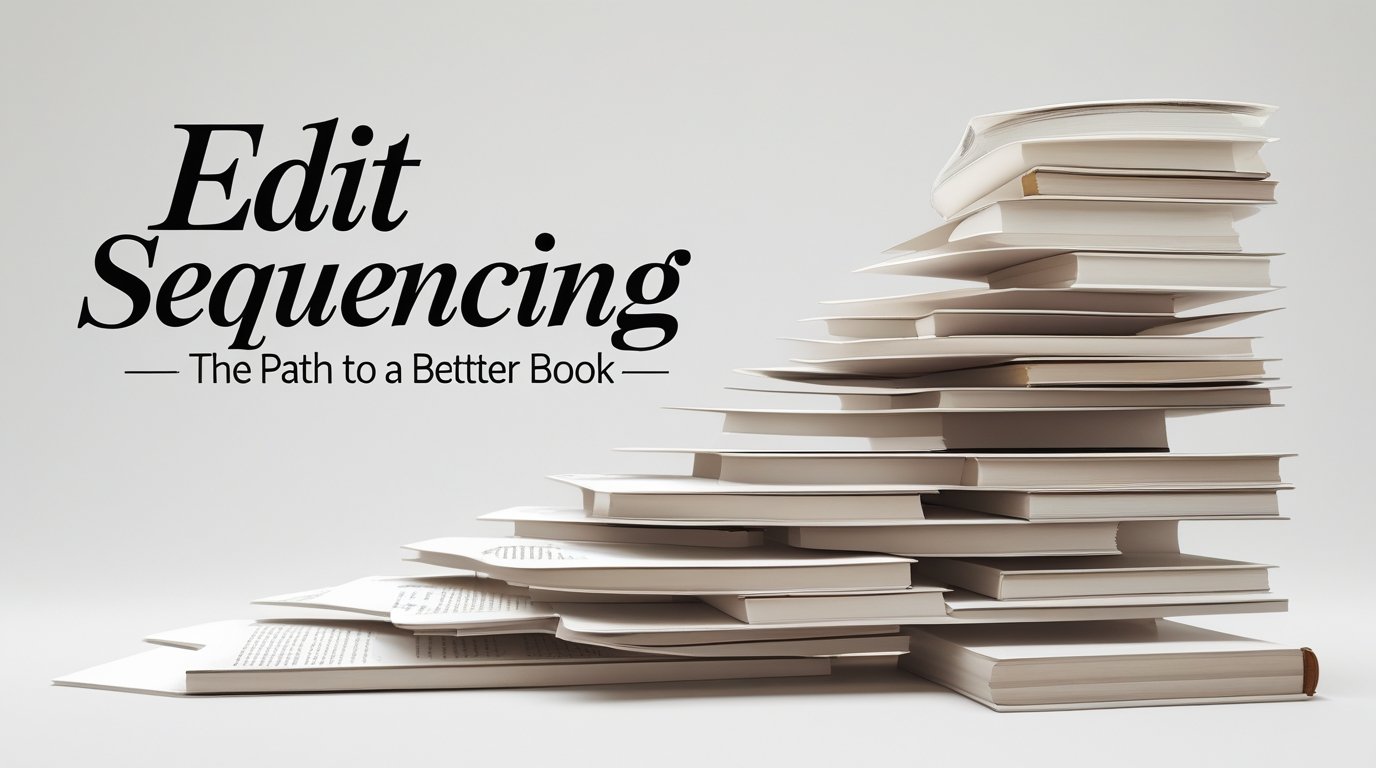
I once spent three weeks obsessively fixing every semicolon in Chapter Four, only to realize later that Chapter Four was so boring it needed to be deleted entirely. I was basically putting premium lipstick on a pig that was headed for the slaughterhouse. It’s the ultimate “writer facepalm”, polishing the brass on a sinking ship while the passengers (the readers) are already jumping overboard. Now, I use a sequence so strict it makes a drill sergeant look like a hippy, ensuring I never waste time beautifying a plot hole again.
1. The “Cooling” Period: Step Away from the Body:
The first step in my edit sequence is actually to do nothing. I call this the “Palate Cleanser.” After I type “The End,” I close the file, and I don’t look at it for at least thirty days. If I try to edit immediately, I’m still too close to the “Creator High.” I’ll see what I intended to write rather than what is actually on the page.
I need to become a stranger to my own words. During this month, I read other books, I go for hikes, and I let my brain reset. When I finally return to the manuscript, I want to feel like a cold-blooded assassin, not a protective parent. You cannot edit effectively until you lose your emotional attachment to your darlings. If you can’t read your own opening scene without cringing just a little bit, you haven’t waited long enough. This distance is the only thing that allows for the “Objective Eye” required to see the cracks in the foundation.
2. Level One: The Macro (Structural Edit):
Once the cooling period is over, I perform the Macro Edit. This is the “Big Picture” phase, where I look for structural integrity. I don’t care about typos. I don’t care about “vivid descriptions.” I am looking for the “Bones.” This is the stage where you determine if your house is built on rock or sand.
I ask myself the hard questions:
- Does the middle sag like an old mattress? (Usually, yes).
- Is the protagonist’s motivation clear, or are they just drifting through the plot like a leaf in a gutter?
- Are there “Ghost Characters” who serve no purpose other than to take up space and confuse the reader?
- Does the climax actually resolve the conflict introduced in the beginning, or did I just get tired and blow something up?
In my experience, this is the most painful stage. This is where I realize that two characters need to be merged into one, or that the “exciting” opening scene actually starts forty pages too early. I’ve deleted 20,000 words in this stage before. It hurts, but it’s necessary. If the structure is broken, no amount of beautiful writing will save the book. I use a Story Map to track the emotional beats and ensure the tension is constantly escalating. If a scene doesn’t move the needle, it gets the axe. You have to be willing to tear down walls if they are in the wrong place.
3. Level Two: Character Arcs and Dialogue Consistency:
After the structure is sound, I move to Developmental Tweaking. I focus specifically on the “People” in the story. I go through the manuscript and read only the dialogue for each specific character. This “Isolated Reading” helps me identify if everyone sounds exactly the same (which usually means they all sound like me).
I’m looking for Voice Consistency. Does my grizzled detective suddenly start sounding like a Victorian poet in Chapter Twelve? Does my hero decide in the finale that contradicts everything they stood for in the prologue without a valid reason? This is also where I check for “Talking Head Syndrome”, those long stretches of dialogue where the characters are just standing in a vacuum, talking and talking. I add in “beats” of action to ground them in the physical world.
But I still haven’t touched the grammar. We are still in the “Heavy Lifting” phase. If I decide to change a character’s backstory now, I’m only changing a few scenes, not a perfectly proofread masterpiece. I want my characters to feel like three-dimensional beings with distinct rhythms, flaws, and desires. If they aren’t leaping off the page yet, I keep digging into their motivations until they do.
4. Level Three: The “Line Edit” (Flow and Rhythm):
Now, and only now, do I zoom in on the Sentences. This is the Line Edit. This is where I look for the flow, the cadence, and the “Music” of the prose. I’m looking for clunky phrasing, repetitive sentence structures, and the “Fluff” we discussed in previous sections.
I read the manuscript aloud. If I trip over a sentence, the reader will too. I look for:
- Alliteration that draws too much attention to itself.
- Sentences that all start with the same word.
- Paragraphs that are too long and dense for the eye to track.
- Weak transitions between ideas.
This is the stage where the book starts to feel “Professional.” I am tightening the screws and ensuring that every word is the best possible word for that specific moment. I am looking for the “Vividness” of my descriptions. Instead of “the red car,” I might write “the rusted crimson sedan.” I am making the prose “High-Definition.” It is a meticulous, slow process, but it is where the “Art” of the book truly shines through.
5. Level Four: The Copyedit (The Technical Polish):
We are nearing the finish line. The Copyedit is about the rules. It is about grammar, punctuation, spelling, and style guides (like the Chicago Manual of Style). I am looking for the objective errors that a spellchecker might miss.
- It’s vs. It’s.
- Dangling modifiers.
- Incorrectly used semicolons.
- Inconsistent spelling of names or places.
I often use a professional for this stage because I am still too close to the work. I know what I meant to type, so my brain will automatically correct “the the” to “the.” A fresh pair of eyes is invaluable here. If you are doing it yourself, try changing the font of your manuscript or reading it backward, anything to trick your brain into seeing the letters as they actually are, not as you imagine them to be. This is the “Clean-Up Crew” phase. It’s not glamorous, but it’s the difference between looking like an amateur and a pro.
6. Level Five: The Proofread (The Final Safety Net):
The Proofread is the very last step before the “Publish” button is pressed. It is the final sweep for the tiny “Gremlins” that survived the copyedit. This is usually done on the “Galleys” or the formatted version of the book.
I am looking for:
- Widows and orphans (stray lines at the top or bottom of pages).
- Page numbering errors.
- Formatting glitches.
The one typo that somehow made it through four rounds of editing.
This is not the time to rewrite a scene. This is not the time to change a character’s name. This is the time to be a perfectionist about the “Presentation.” Once this is done, the sequence is complete. You have moved from the “Earthquake” of structural change to the “Microscope” of formatting. By following this path, you ensure that every minute you spend editing is spent on something that actually matters.
The Bottom Line:
I learned the hard way that a perfectly punctuated paragraph won’t save a boring story. Edit sequencing is about working from the “Big to the Small.” Fix the bones, then the muscles, then the skin, and only then do you put on the makeup. By moving from structural “Heavy Lifting” to technical “Fine-Tuning,” you protect your time and your sanity. A book is built in layers; make sure the bottom ones can actually hold the weight of the top ones.
FAQs:
1. Why can’t I just edit as I go?
Editing while you write (The “Infinity Loop”) often prevents you from ever finishing the draft. It’s better to have a “Dirty” finished book than a “Perfect” first chapter.
2. What if I find a major plot hole during the Line Edit?
You have to go back to Level One. It sucks, but ignoring it will ruin the book. This is why we do the Macro Edit first—to minimize these “U-Turns.”
3. How many rounds of Macro Editing do I need?
As many as it takes for the story to be logically sound and emotionally resonant. For some, it’s one; for others, it’s five.
4. Can I skip the “Cooling” period?
You can, but your editing will be significantly less effective. You need the “Objectivity” that only time can provide.
5. Is professional editing worth the cost?
If you are serious about publishing, yes. A professional editor sees things you are physically incapable of seeing in your own work.
6. What is the most common mistake in edit sequencing?
Starting at Level Four (Grammar) before finishing Level One (Structure). It’s the “Polishing the Pig” syndrome.